Thursday, 26 October 2017

🤖 Is My Job Going To Be Automated?

What you can do now if a robot is coming for your job.
Is My Job Going To Be Automated?

Photo by JD Hancock

One of the summer jobs I had growing up was working in the exciting shipping department in my family's small-to-medium size business.

Scratch that. It was boring.

No, it was beyond boring.

Most of the time was spent unpacking clothes from boxes, hanging them on racks, and then later rearranging them, packing them into different boxes, piling the boxes on pallets and moving the pallets to the shipping dock to eventually be loaded onto trucks and sent off to clients.

The main differences from one order to the next were the clothes and box sizes. Otherwise, it was lather, rinse and repeat.

Chatting with co-workers slowed down the work noticeably in that assembly line atmosphere, so the only way to keep your sanity was by working within earshot of the radio as much as possible.

When I first started at 14, I was just happy to be working and earning a paycheck while helping my family. Pretty quickly though, I couldn't wait for it to end.

There were days where I would have paid for a robot to stand in for me, or so I told myself.

Back then in the early 00's, automated systems existed that could have done the entire process much faster but they were far too expensive to justify for our company.

Even when a friend helped me move on to a much larger shipping department with many more orders coming in and going out daily, it probably still didn't make much sense… it was just cheaper to have a team of minimum wage employees doing the work manually, as long as everyone was careful to avoid any expensive accidents (which happen all the time in such places, unfortunately for everyone involved).

That's probably not true anymore, however.

Note: There is a poll embedded within this post, please visit the site to participate in this post's poll.


With technology improving all the time, those automated systems have become much cheaper and more accessible even to the smallest of businesses. As a result, we've been hearing more and more scary warnings over the past few years about how many people are going to lose their jobs to robots, automation or technological advances plain and simple.

For example, an October 2017 PWC study estimates that almost 30% of all jobs in OECD countries will be replaced by automation by the early 2030s, with the United States to be particularly hard hit:
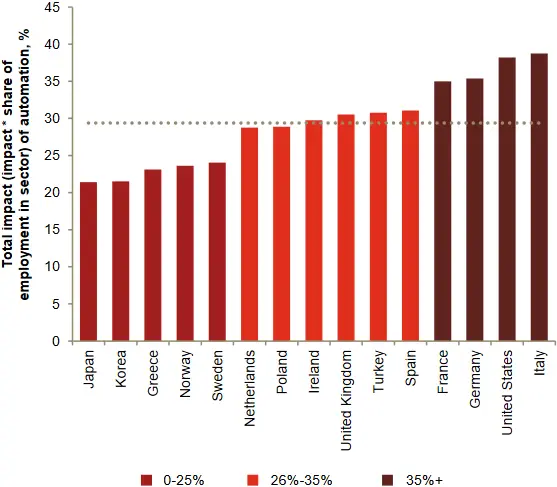
Total OECD impact of automation by 2030s

Which industries are most at risk?

The PWC study has a graphic for this too:
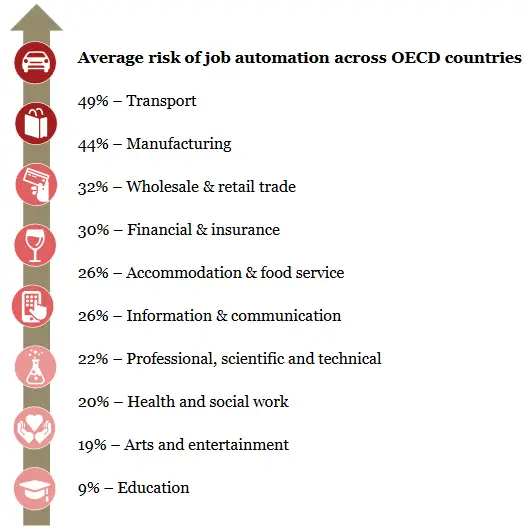
Industries most at risk of job automation in OECD countries

PWC's conclusion:

the sectors most at risk often involve manual or routine tasks, for example filling forms or solving simple problems. In contrast, sectors at low risk such as education and health care place a much greater focus on social and literacy skills which are relatively less automatable

Which professions are most at risk?

Visual Capitalist created this chart comparing the results of Frey and Osborne's 2013 study The Future of Employment: How Susceptible Are Jobs to Computerisation? with official 2016 US Bureau of Labor employment statistics.

Black bars show jobs that are more likely to be replaced, white bars are the opposite:
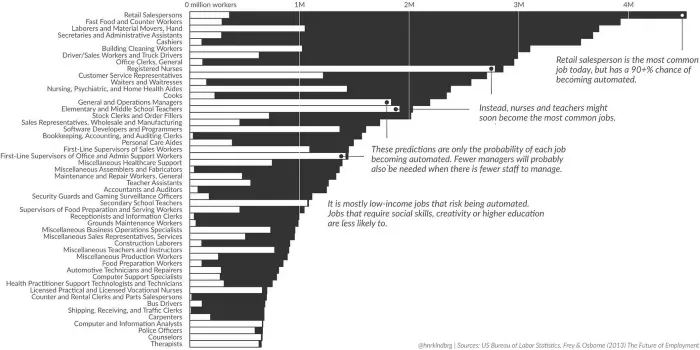
visual capitalist automation and unemployment chart

(Click here to see a much larger version of the chart)

Their conclusion:

It is mostly low-income jobs that risk being automated. Jobs that require social skills, creativity or higher education are less likely to.

Is this something you need to worry about?

It depends.

At a glance, the numbers are scary but while the 30% mentioned in PWC's study is a lot, the flipside is that 70% of all jobs WON'T be replaced by automation by the 2030s, so there's a good chance you're safe.

If you're relieved that both Frey and Osborne's study and the PWC study agree that automation is mostly a blue collar concern, don't overlook that PWC estimates 22% of “Professional, scientific and technical” jobs to be impacted too, so white collar workers should pay attention moving forward too.

If you're over 45 and you don't feel the heat of automation in your industry yet, you'll probably old enough to retire before the automation wave arrives.

But if you're not old enough to retire by then, or regardless- if you really think your job is one of the ones more likely to become obsolete sooner than later, what can you do?

3 ways you can protect yourself from being automated out of a job

1) Move to a place where there's both more demand and less automation risk

Your entire industry won't automate overnight and lay off all the replaced employees in one shot. It's going to be a very gradual process that will take years.

If you suspect a layoff is coming, use job boards to gauge where there's still demand for people like you and consider moving where there's the most demand. It might even be in another country, such as one where the pace of automation is much slower for whatever reason.

When doing your company research, try to understand if a given employer is planning to automate sooner than later. It would be a shame to find a job only to be laid off again within a year or so.

2) Specialize

If you brand yourself as a top expert in your disappearing field, or in a disappearing niche in your field, you can dramatically improve your chances of staying in that field.

Technology replacing professions isn't a new thing. Most everyday professions dating from before the Industrial Revolution were replaced long ago, such as all kinds of smiths and makers.

However, even today you can still find people who practice these professions in specialty boutiques and artisan or craft workshops.

Often, these experts are carrying on a tradition, whether a family one or a local one, such as gondoliers in Venice.

Sometimes, they're just meeting demand that has fallen through the cracks. There's a shoemaker not far from here who you can't buy shoes from, but you can get a heel fixed there or a clean hole added to a belt.

Taking a look at more modern industries, as long as there are companies that rely on older technology, there will still be a need for people to maintain it. When the Y2K bug was discovered at the end of the 20th century, there was a surge in demand for programmers who could fix old computer systems that were affected.

A more automation-related example would be that the systems replacing human workers will still need some people who understand them and can check that they're actually correctly doing whatever it is they're supposed to do.

3) Use your transferable skills to change careers

You have skills.

Many of your skills are useful for other professions as well, which is what makes them “transferable”.

If you can identify unlikely-to-be-automated professions that most value your transferable skills, it'll be easier for you to change careers and escape the automation wave.

a) Start by listing your transferable skills

Many experts recommend some form of self-assessment, but career coach Ford Myers – listed in my 50 Career Coaches Who Give Free Consults On Every Topic You Need – hits the nail on the head in this short video with a different take:

The rule of thumb I recommend is to start by browsing your work portfolio for all the compliments, great evaluations, LinkedIn recommendations and other positive things people have said about you, and make a list of the skills mentioned.

Next, add to your list by following Ford's advice to ask relevant people about your greatest skills. If you find them hesitant, ask them for feedback on your initial list.

b) Find professions that most value your transferable skills

If you look back at Visual Capitalist's chart above, the jobs with long white bars are the ones most likely to not be replaced by machines. Look through the list for appealing jobs you think you could do, and then research the skills they require to see how well you qualify, perhaps even with some retraining.

Another angle would be to check the projected fastest-growing professions for the next decade or more, and then do the same skill-matching exercise.

c) Get out and information interview
2017 job action day badge

Once your skill-matching research has lead to a few potential new career directions to consider more seriously, it's the perfect opportunity to reach out to people in those jobs for information interviews.

“I'm considering switching to your profession, and want to hear more about it from someone who's succeeded at it” is a great excuse to invite someone for coffee and ultimately get an opinion on whether you'd be a good fit in their role.

This article is part of Job Action Day 2017. This year's theme is “Using Transferable Skills to Give Your Career New Life“.

Question of the article

If you've changed careers in the past, how did you do it? Tell us in the comments.

Subscribe to JobMob via email and follow me on Twitter for more ideas on what to do when your job goes obsolete.


via JobMob More Information Here..

Thursday, 19 October 2017

😤 25 Ways to Breathe Life into a Painfully Long Job Search

If you're sick of looking for a job, this is for you.

25 Ways to Breathe Life into a Painfully Long Job Search

Photo by Alex Siale

Although most of these tips are useful for any job seeker, all of them are intended for people who’ve been job searching for much longer than they expected, possibly even a year or more.

My own long job search story

In December 2001, I started looking for a career job in Israel for the first time, having taken a few months to relax after resigning from my managerial position at Amazon.com in France.

In July 2002, 8 months later, I didn’t have much to show for my job hunting efforts and with my savings dwindling, I was starting to feel a little desperate and more alone than ever on my job search. However, I made one major change to my job search strategy and within a few weeks, I entered the recruitment process that resulted in my starting a new job on October 1st of that year.

That major change I made is #25 at the bottom of this list of tips for others like myself who know too well the frustration of a prolonged job search.

Note: There is a poll embedded within this post, please visit the site to participate in this post's poll.

25 tips when feeling hopeless about job search

1) Open yourself to change

There’s a fine but clear line between getting into a job search groove and a job search rut: in the former, you actually feel like you’re getting somewhere, moving closer to your next job, while the latter seems to go on forever.

Once you get into a set of habits, it’s not easy to change out of them, and it’s never easy to experiment when you feel that your livelihood (and reputation?) are in the balance, but you will need to embrace change if you’re not getting the job search results you desire.

2) Take a short vacation to recharge your batteries

Vacations are also good for inspiration and meeting people, plus- haven’t you ever felt like your best ideas sometimes come to you when your mind is 100% thinking about something else?

3) Stay positive

I know you're tired of not finding a job, but no one’s going to give you a job interview out of pity, and no one’s going to hire you out of pity. You need to stay upbeat while job hunting; your next job literally depends on it:

Do whatever it takes. Build on the successes of little things like finding a new job lead, making a new contact, etc., and by letting little achievements from outside of the job search throw some good feeling into your job search.

Another way to get the positive juices flowing is exercising regularly.

4) Stop job searching alone

For the 8+ months of my 2002 job search above, I spent almost every single day getting tired in front of my computer looking and applying for jobs online, rarely ever meeting with anyone outside of the occasional interview. It was no wonder that I felt alone and isolated, which certainly didn’t help my morale.

Instead, look for every opportunity to job search with other people, both job seeker and not, both online and off.

Have lunch weekly with other job seekers you know, hang out here on JobMob asking questions, and so on.

I wish I had known of such options back in 2002 when I struggled so much to find a job.

5) Write your curriculum vitae as if it was the first time, making a full job history you can reference moving forward

Go back to the beginning of your career. For each job you had, list your title, required skills, responsibilities, achievements and anything you were proud of.

Numbers are good if you have them.

Were there any memorable stories that may be worth recalling in a job interview? Jot them down too, for each position.

Can’t remember all the details? Use that as an excuse to re-establish contact with past colleagues or former employers.

6) Get an independent, expert audit of your job search to date

Go over what you’ve done well, what you’ve done wrong and get specific, actionable ideas of what you should be doing right now to change your luck.

Look for such help from your college/university alumni association, local employment center, favorite blogging job search expert, etc.

7) Hire a job search coach

They can conduct the above audit with you, and give you those kickstart ideas.

8) Reach out to local headhunters who specialize in your industry

They’ll immediately know if your skillset is in demand based on what their clients are looking for, among other things. They may also have better analysis on why all the job rejection.

Get a second opinion too; you don’t want to make any decisions based on just one person’s thoughts.

9) Consider relocation

Perhaps there really is no demand for your skillset locally. The farther you’re willing to move, the more job opportunities you open yourself to.

10) Consider remote work

If there’s no local demand for your skillset, find out where there is demand and apply for a teleworking opportunity. This allows you to respond to a company’s needs without the radical changes of a potentially unnecessary move, or possibly to test the waters before such a move.

11) Update your skills

The irony of having a job is that you’re often so busy, you don’t have time to refresh your knowledge, and this can even be true in countries where employee education budgets are required by law like in France.

Technology is always advancing, discoveries are being made, new ideas are practiced. If you’ve been job searching for a long time, stop to look around and make sure you know what you need to get a job today, not what you needed to know a year ago. Add value.

12) Learn new skills

When meeting local headhunters, ask them which skills are most in demand. Browse recent job board listings to corroborate, and choose the skills that can most increase your worth within a reasonable amount of time.

Then start learning every day. If you’re not someone who learns well on their own, take a course online, sign up for workshops at a local community center, college or institute. Again, add value.

13) Followup with old contacts

You probably told everyone about your job search back when you began looking?

That was well over 6 months ago, and unless they know better, they may think you’ve already found something. Send a gentle reminder that you’re still available.

14) Stay in touch with your contacts

Once you’ve reached out to someone, whether at the beginning of your job search or now so much later, stay in contact with them so that they are less likely to forget about you.

Also, don’t break contact again once you do find something, leaving them feeling used. Perhaps you can help them back somehow.

15) Find new contacts

Over months of searching, it may feel like you’ve exhausted all your contacts. Discover new networking opportunities by joining local associations or networking groups, attending conferences and meetups (find them here), both offline and online; if they’re locally-based, you can then carry over an online meet into a real world meet.

Learning new skills (#6 above) will also introduce you to new communities of people.

16) Reapply to a former employer

As long as you left a good impression on the way out, they may only be too happy to have you back since they know what you’re capable of, making for a shorter, less-expensive recruitment and a quicker integration.

Another good reason to stay in touch with your ex-colleagues and ex-bosses (at least, the ones you enjoyed working for).

17) Start freelance consulting as soon as possible

Whether you’ve been looking for work for 1 week or 1 year, get yourself business cards that say you’re a consultant in your field of professional expertise.

When people ask what you do, reply “I consult on X, but am also available for full-time work” and hand them a business card, which leaves a better impression than just saying “I’m looking for a job”.

Plus, you might even get some clients, which is a great way to fill a resume gap while potentially leading to a permanent position with a client company or business partner they referred you to.

18) Offer job trials to prospective employers

Let employers see what you can do by working in a temporary job capacity for them or on a per-project basis.

However, the end goal should be definitive i.e. a ‘yes or no’ achievement, to prevent employers from taking advantage of you.

19) Get a temporary job

Use a temporary job to impress employers into finding ways to convert the position into a permanent one. Also a great way to build your network of contacts even more, and discover other jobs, both temporary and permanent.

You might even decide you like the temping lifestyle and aim for those types of positions, which are in constant demand due to natural company turnover.

20) Line up information interviews

If you need a hook, find a magazine/trade publication/blog (your own?) to whom you can submit an op-ed or guest post and then tell companies how you’re researching an article for them. If you write well, aim for this interview reason first.

Otherwise, you can always take notes or record the interview on your cellphone and then hire a freelance writer to finish the article for you.

21) Be selective in which positions you choose to apply for

Aim for the quick win by applying for jobs you have already succeeded in. This will mean fewer jobs to apply for, but will increase your chances of finally getting a positive response.

Fewer job applications also means less demoralizing rejections or non-responses, and more time for other more interesting job search activities listed here.

22) Avoid career changes

Similarly to the previous tip, now is not the time to look for a change in career direction. It’s much harder to convince someone you can do a job without any experience than when you’ve already succeeded in that role.

That said, be open to new opportunities if such an unexpected offer comes your way.

23) Volunteer

There are many reasons to volunteer while on a job search, but these are even more true on a prolonged job search.

Achieving through volunteering will improve your morale in leading to new contacts while potentially improving your skills, if you choose an appropriate organization to volunteer for, such as the leading association of professionals in your industry.

24) Consider a move downward

Like an army that retreats to fight again another day, it’s better to take a step down the career ladder than stay off it entirely.

This can be tricky as employers may see you as overqualified and you may be frustrated by not being able to show off all that you can do. All that really matters is what you can achieve for your new boss and how you can leverage that into a position that will allow you to meet your potential.

Even entry-level jobs can be used to springboard you back up the ladder again.

If you do take a step down, start looking again as soon as you're ready:

25) Be flexible

Take a good hard look at the self-imposed limits of your job search and decide which limits you can remove, opening yourself to new job opportunities.

In the story of my 2002 job search in Israel, what made a big difference was my decision to no longer limit myself to jobs in Israel itself, and with that, my wife and I returned to France with a good job in hand, found almost immediately after I’d become more flexible.

Bonus tip

26) Keep trying!

Don’t give up looking. New opportunities can appear at any time.

In hockey, a goal scorer in a slump will eventually score as long as he keeps shooting pucks at the net. Likewise, if you persevere in following best practices while trying new ideas in looking for leads, growing your network and improving your skills, something will eventually come your way.

Question of the article

If you overcame a long job search, what was the turning point? Tell us in the comments.

Additional reading

READ NEXT: Stop Falling into Resume Gaps

Subscribe to JobMob via RSS or email and follow me on Twitter for more insight on ending long job searches.


via JobMob More Information Here..

Wednesday, 4 October 2017

📃 Why Paper Resumes Aren’t Going Away Anytime Soon

For years, people have been saying that paper resumes are dead. Are they really?

Why Paper Resumes Aren’t Going Away Anytime Soon

Photo by clive darra

The hype

Search Twitter for “paper resume” and many of the results are articles announcing that the Internet-based resume era is here.

Free bonus: The One Resume Resource You’ll Ever Need is a handy reference to make your resume get you more job interviews. Download it free now

But who has actually been saying they’re dead?

1) Companies who stand to gain from you not using them, such as video resume companies

While video resumes and paper resumes will both help you on your job search, one doesn’t negate the other as you might think after seeing the above tweet. They’re both personal job search marketing tools that can make an impact when used appropriately.

2) Recruiters who don’t want to deal with paper resumes anymore

And I don’t blame them.

Since I started JobMob back in 2006, I’ve received hundreds of resumes via email and have viewed many more online. I’m not a recruiter, but if I had to store all those as paper somewhere, my home office would need a second floor.

As it is, whenever a job seeker hands me their resume at a networking event or job fair, I’ll always tell them to save it for others at the event without forgetting to email it to me later.

3) Personal branding experts, like me

In my 5 Most Interesting Notes From the 2010 Israeli Recruitment Conference, I mentioned that-

Morit Rozen even said that “the resume is going to die” – I disagree; more on that another time – and that soon, recruiters will just want names and use the Internet to find everything else. She suggests googling yourself right now (“לגגל” – l’gagel) to make a quick assessment of your situation, and I definitely agree with that.

And I still do.

But even if I’ve been recommending for years that you regularly build your brand online through social media, personal websites, blogging, or whatever combination makes the most sense for you, that still doesn’t mean you don’t need a paper resume any more.

The truth

Reasons why you still need a paper resume:

  1. Even in 2015, many companies still aren’t fully digital, especially smaller companies who make up the majority of any major job search market
  2. Be different. When everything is going virtual, the few people who successfully manage both the online and the offline will really standout. (This is why some people are still using fax machines to get their resumes in the door)
  3. Digital resumes get lost just as easily as paper ones. Resume copies you bring to interviews might be the only ones in the room, and the interviewers will appreciate that when it happens, especially when they go on to take notes directly on your copies.
  4. Like a business card, a resume crisply printed on high quality paper leaves a professional impression wherever you go: networking event or job fair.
  5. To show off your creativity

The proof

In May 2014, I posted the following poll to JobMob:

Note: There is a poll embedded within this post, please visit the site to participate in this post's poll.

If the paper resume was truly dead, why would such a high percentage of people still be using them?

Free Bonus

If you want a handy resume and CV resource that you can keep on your smartphone or print out for easy reference, this special bonus is for you.

This free download contains:
  • 111 Smart Resume Section Headings and Titles
  • 60 Resume Achievement Writing Ideas and Expressions
  • 500 Positive Resume Action Verbs That Get Job Interviews
  • 35 Resume Filenames Recruiters Won’t Respond To
Click the image below to get access to The One Resume Resource You’ll Ever Need: The One Resume Resource You'll Ever Need download button

JobMob Insiders can get this free bonus and other exclusive content in the JobMob Insider Bonuses area. Join now, it's free!

Subscribe to JobMob via email and follow me on Twitter for more thought-provoking job search insights.


via JobMob More Information Here..

Thursday, 28 September 2017

📵 Why You Should NOT Answer the Phone When Recruiters Call, Stupid

Better a return call when you're ready than a missed call when you aren't.

Why You Should NOT Answer the Phone When Recruiters Call

Photo by Matthew Kane

This is a guest post by Graeme Gilovitz.

This has to sound like the stupidest idea you have ever heard.

How can you get the job if you don't actually talk to someone?

Even today, when you can communicate via so many media such as email, SMSes, WhatsApp, LinkedIn, Facebook Messenger and any other applications, the only way to actually get the job is to talk to someone on the phone at some point and then meet them.

Yet…

Note: There is a poll embedded within this post, please visit the site to participate in this post's poll.

Two reasons to ignore recruiter calls

1) Get prepared

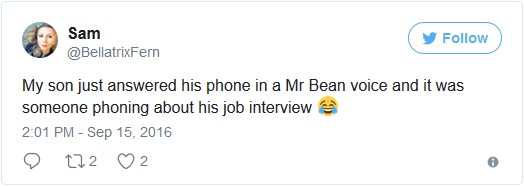
son job interview answers phone as mr bean

As a recruiter, we love to catch people off guard because then we get to see (or in this case, hear) the real you and how you behave. Your tone gives us a great insight to your attitude, personality, politeness and professionalism.

So when we call and you have no idea who we are, where we are calling from or what role you applied for, you are already on the defensive and the power is with the recruiter. Most likely, you have applied for a few jobs and after a while the calls all sound the same which makes it harder to answer any of their phone questions.

It would be funny if it weren't so true.

This little conversation is the first stage of the interview process and needs to be treated with as much preparation as a face-to-face interview, even if the call only lasts 5 minutes.

Not answering the call gives you time to gather all the relevant information regarding your application, find a quiet place to talk and focus on answering their questions as well as you can. You can’t do any of that when you are taking calls on the fly, especially in a noisy area.

So instead of rushing to take the call, call them back.

2) Play hard to get (a little)

miss job interview call slept in tweet

When someone is a too easy to get hold of, it gives the impression that you are sitting by the phone all the time, which translates into “I am desperate for a job”. But if you play a bit hard to get, you can increase your “perceived value”.

You can always tell them later that you were in an interview, or a meeting, etc., giving the impression that you must be a valuable potential candidate because other people are already meeting with you (simple logic of supply and demand).

Alternatively, just say that you were “unavailable to take the call” – the most universally used excuse ever.

What to do after ignoring the call

interview call back anxiety tweet

When you actually return the call, follow these tips:

  1. Find a quiet place to talk and more importantly, where you can listen
  2. Have a copy of the recruiter's job ad ready – make sure that you have reread it and have notes
  3. Have a copy of your application (resume and cover letter) to reference, and especially selection criteria (if there were any)
  4. As you know the name of the person who called (if they left you a message) and where they work, do some background digging – try LinkedIn and Facebook. I wouldn't recommend you using this information but at least you'll know who you are dealing with
  5. Apologize for not being able to take the call
  6. Have note paper and pen in case they mention anything useful or ask you for an interview and they provide details
  7. Anticipate the questions that they might ask

What happens if they don't leave a message or you accidentally answer the call?

  1. You need to get off the call ASAP no matter what!
  2. Apologize and explain that it isn't a convenient time to chat “as you are expecting an important call” and ask that you call them back at an agreed time
  3. Take their name, company, phone number
  4. Revert back to the above tips

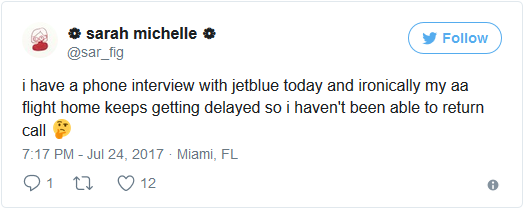
Ring ring – what are you going to do?

flight delay prevents jetblue interview call tweet

READ NEXT: How To Video Job Interview With Your Cellphone

Bonus: A Recruiter Calls, But I'm Not Prepared

About the author

graeme gilovitz portrait

Graeme Gilovitz is Director of Summit Resumes and Summit Talent (an Australian-based recruitment agency with an international reach and client base), & has worked in-house with the some of the largest companies in Australia. With a background in advertising and marketing prior to recruitment, Graeme possesses an unique perspective on communication, the recruitment process and how to ensure that you get the most out of your job search. He blogs regularly, focusing on his insights.

Subscribe to JobMob via RSS or email and follow me on Twitter to get the most out of mobile video on your job search.


via JobMob More Information Here..

Wednesday, 20 September 2017

✈ 50 Great Jobs You Can Easily Do While You Travel

Use your laptop to pay for travel, while you travel.

You might just discover a new career while you're at it.

50 Great Jobs You Can Easily Do While You Travel

Photo by Andrew Neel

Background

In a posting to the Digital Eve Israel Yahoo Group, a group member asked the following question:

“Any leads on how to find a job that can be done on my laptop, here and there, so that I can still pay my bills while traveling?”

This reminded me of the time when I was still a programmer at Amazon.com back in 2000.

Living in Paris but working daily over the Internet with people in Seattle, I wanted to visit my family in Montreal without taking a lot of vacation time either. Luckily, Amazon's computer systems allowed people to connect from outside the office and that made it easier to convince my boss to let me go.

In the end, I only took off 2 days for traveling purposes and otherwise worked full days from my parents' house, basically paying for my trip and expenses. A side benefit to Amazon was that having me in a middle time zone (6 hours behind Paris but 3 ahead of Seattle) made some projects easier to finish on time.


Freelancers and small business owners

Join 4 million freelancers who use Payoneer’s payment solutions:

  • Lower fees
  • Faster payment
  • Greater flexibility
Sign up and get $25*

Working while traveling abroad and telecommuting aren't quite the same thing

People usually associate telecommuting with a full-time job that lets you regularly work from home, but it can also be a part-time job on the road.

To best answer the question above, let's set out some criteria that make more sense regarding jobs for travelers. Those jobs usually need to be:

  • Jobs you can do over the Internet
  • Jobs that can be done over a short time-span i.e. during your travels
  • Jobs you can get on short notice

This last one is important in case you need multiple jobs to pay all your bills during your trip.

So we're dealing with freelance jobs. However, if you choose well and deliver well, a short-term freelance job can become a longer-term freelance job that you continue from home after traveling.

Jobs you can do while traveling

With that in mind, the list below of online jobs for travelers should give you all sorts of ideas. Each job title points at a real job description, and if the description isn't a good match for you, just do a search on the job title to find more open jobs like it.

  1. 3D and Flash Animator
  2. Accountant
  3. Advertiser
  4. Administrative Assistant
  5. Article Writer
  6. Billing and Debt Collection Representative
  7. Blog Programmer
  8. Career Coach
  9. Virtual Assistant
  10. Advertising Poster
  11. Copywriter
  12. Customer Service Representative
  13. Data Entry Provider
  14. Data Specialist
  15. Database Developer
  16. E-book Writer
  17. Email Template Designer
  18. Flash/Web Developer
  19. Graphic Artist
  20. Caricaturist
  21. Marketing & Lead Generation Campaigner
  22. Logo Designer
  23. Online Tutor
  24. Personal Assistant/Secretary
  25. Press Release Writer
  26. Project Manager
  27. Recruitment Researcher
  28. Sourcer (not sorcerer!)
  29. Resume Writer
  30. Sales Presentation Designer
  31. SEO Analyst
  32. Foreign Language Voice Talents
  33. Technical Support
  34. Telemarketing Professional
  35. Transcriptionist
  36. Travel Planner
  37. Typist
  38. Video Editor
  39. Web Content Writer
  40. Web Designer
  41. Website Translator
  42. Stock Photographer
  43. Voice-overs
  44. Cartoonist
  45. Real Estate Researcher
  46. Business Consultant
  47. Legal Advisor
  48. User Guides and Manuals Editor
  49. Game Developers
  50. Travel Writer

Don't think this is possible? Not for you?

See how these laptop warriors have built careers while traveling:

Bonus tip for beginners

Like with any job, having work experience will help a lot compared to a candidate who has no experience. But even having just a little bit of experience will make a difference because it will still allow you to tell potential employers “I've done this online before”.

With that in mind, get experience before your travels by doing some quick, cheap projects. This has the added benefit of getting you familiar with freelance marketplaces, negotiation with potential employers, and actually getting paid with all that's involved.

It would suck to be in a foreign country expecting to receive your pay the next day only to discover that you need to wait a few more days because of some strange policy you didn't know about. Practice before you go!

GET STARTED NOW: Top 50+ Freelance Marketplaces Online and Top 25+ Micro Freelance Marketplaces and Why You Should Use Them

Question of the article

Have you ever worked while traveling for pleasure? How did you find the job? Tell us in the comments.

freelance traveling jobs tweet

Subscribe to JobMob via RSS or email and follow me on Twitter for more travel job search ideas.


via JobMob More Information Here..

Thursday, 14 September 2017

🚩 One Surprising Reason Recruiters Aren’t Responding To Your Job Applications

Recruiters can only respond to your email if they actually get it.

One Surprising Reason Recruiters Aren't Responding To Your Job Applications

Photo by Karl Fredrickson

One of the most frustrating things about the job search process is the uncertainty. What's it going to take to find that next job? How long will it take? And so on.

There's a particular kind of uncertainty that drives job seekers crazy: not getting a response from recruiters.

When I ask my readers what their biggest job search challenge is, this problem comes up again and again-

  • “not hearing back”
  • “I have sent some CVs out but haven't gotten responses.”
  • “The biggest problem I have is getting responses to my job applications.”

I used to get so many complaints about this that I once blogged An Open Letter to the Recruiters of the World From Job Seekers Everywhere, and that was just to get recruiters to auto-respond to job applications.

If you're like most job seekers, you are probably more likely to be bothered about the lack of recruiter response than you are about getting rejected. Crazy but true.

Here's the thing though-

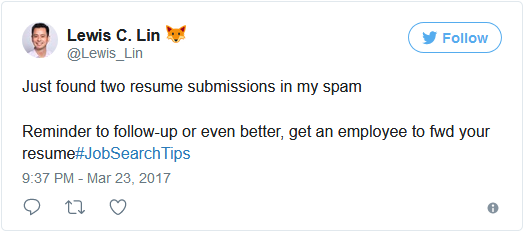
That lack of response is often because of something you did: sending an email job application that was automatically flagged as spam.

lewis c. lin resumes in spam folder tweet

You get aggravated by not hearing back, but the recruiter never even saw your email, and good luck getting them to check their spam folder when you have no better way of contacting them directly.

Stop shooting yourself in the foot.

Here's what you can to do to increase your chances of getting to recruiter inboxes. And you'll see how I also have to do better.

Note: There is a poll embedded within this post, please visit the site to participate in this post's poll.

3 ways to avoid recruiter email spam filters

A) Blacklist check

If your job search email address is from Gmail, Yahoo or Outlook, you can skip this tip and go on to the next one, but pay attention if your email address is from your own personal website or any kind of organization (your current employer?) that regularly sends marketing emails such as client newsletters.

Email spam being the massive problem that it is, companies and others have compiled blacklists of mail servers that are being used for spamming. Spam filters then check incoming email against those blacklists.

If you're sending email from a blacklisted server, your email will be flagged as spam and the recruiter will never see it.

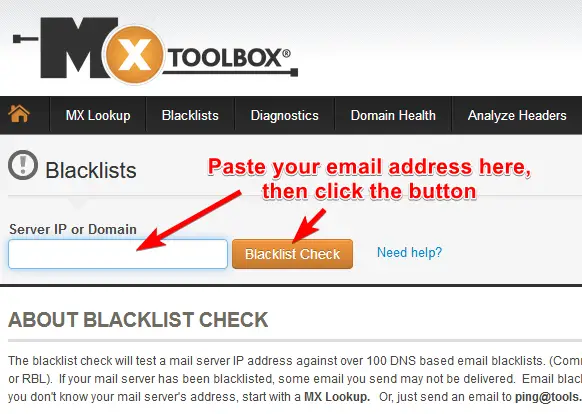
Use a free tool such as MX Toolbox's Email Blacklist Check to quickly check over 100 different blacklists for the mail server used to send your email:

mxtoolbox email blacklist check

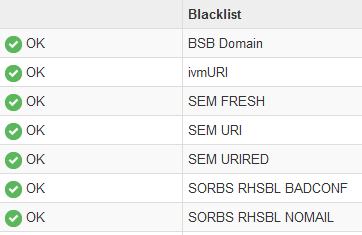
Running the check will generate a list of results. If all goes well, you should a lot of green OKs like this:

mxtoolbox-ok-results

However, if you see any red LISTED results, consider getting a different job search email address before applying for any more jobs over email.

You can also compare your results with another tool such as IsnotSPAM.

B) Score how spammy your job application emails are

A email blacklist check is just one kind of anti-spam tool you can use. Another kind will take your email and score it according to how likely it is to be considered spammy by spam filters, such as Mail-tester.com.

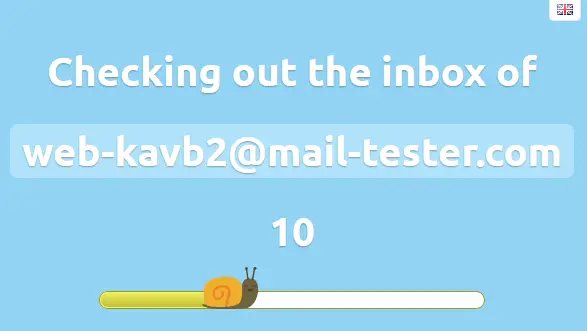
Before emailing a recruiter, send your job application email – the actual email you were planning to send – to a unique mail-tester.com email address shown on their homepage:

mail-tester homepage

Next, click “Then Check Your Score” and Mail-tester gets to work scoring your email:

mail-tester-tool-checking

When it's done, your final results will show where your score lost points:

mail-tester-tool-results

Clicking any line in the report will provide details. You can actually see my results here.

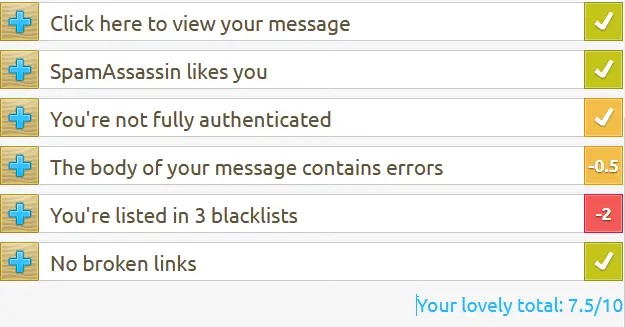
For this test, I simply forwarded a recent newsletter I'm subscribed to, which means that their message “contains errors”.

More importantly:

Argh! My email server is on 3 blacklists!

It's only 3 lists out of 21 checked, so I should be ok, but it's still worth trying to do better. I want to be sure my email will always get to where I want it to.

C) Avoid doing things like a spammer

Spam filters use many rules to score your email in deciding if it's spam or not, just like Mail-tester above.

SpamAssassin, one of the most popular spam filtering programs out there, provides tips on their official website on how legitimate email senders like you can get your non-spam email past their filters.

Based on those tips, here are some of the most common things you should avoid in your emails to potential employers:

1) Email priority

If you're using Outlook or another email program that lets you set priorities, don't set your message to high priority/importance. Classic spammer tactic to make their junk stand out in an inbox.

2) BCC

Don't send your job application to multiple employers by using the BCC (blind carbon copy) option.

If blindly emailing different people the same generic message isn't spam, what is?

3) Subject lines

alisha blake nudes resume email subject tweet

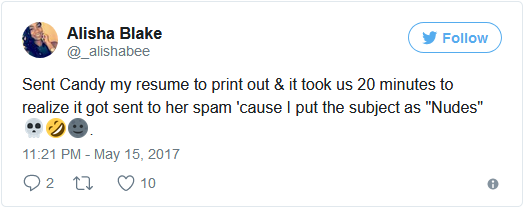
Don't leave your email subject lines blank. That screams ‘spam!'

A subject with an exclamation point can also look spammy, especially when together with a question mark.

If you need ideas for your great subject lines, there are so many good ways to fill them.

4) Email content

Don't address the recipient with a “Dear Madam,” “Hi friend,” “Hey girl,” or anything remotely generic. Where job seekers are more likely to trip up is with a “To whom it may concern” or similar, which is just as bad. Do your company research to get a contact name.

Your conversations with recruiters often start with an email cover letter, and that shouldn't include any special formatting or attention-getting design using colors and images.

You definitely don't want to use any spammy language such as “urgent reply needed”, even if you clearly do want a response asap. Even mentioning sums of money, such as how much you earned for a past boss, can look spammy.

5) Attachments

Some experts recommend not attaching your resume but it really is common practice. However, stick to safe file formats such as PDF, RTF or DOCX as opposed to any kind of compressed file (ZIP, TAR, RAR).

There's no reason your resume should be larger than 1 MB (and even that's quite large for a 1-2 page document) and large attachments will look suspicious.

6) Marketing email tools

In How These Smart Job Seekers Used Blogging To Find Jobs, I compiled case studies of job seekers who used a blog to find a job.

Many of them were in the marketing industry and mentioned how they used professional marketing tools as part of their “job search campaigns”.

If you're also thinking of being creative and e.g. using marketing email tools to spam mass email recruiters, your emails will have a much higher chance of being flagged as spam unless you know what you're doing. Be careful.

Finally, you can test all these tips but by checking what's in your own spam folder.

What other experts are saying

Question of the article

Has a recruiter ever told you that your resume was caught in their spam folder? Have any other spam story? Tell us in the comments.

Subscribe to JobMob via email and follow me on Twitter for more funny tips on good decisions for your future.


via JobMob More Information Here..
Thursday, 7 September 2017

👉 One Handy Job Interview Technique You Need to Master

Start your first impressions with a good first impression.

One Handy Job Interview Technique You Need to Master Today

Photo by Jonas Vincent

Have you ever noticed this?

People shake hands all the time. Unless your handshake is particularly bad, people will rarely react negatively to it and they'll ignore the occasional jitter or semi-clasp. On the other hand (pun intended), if your handshake is particularly good, you will stand out and people will remember you.

But here's the kicker:

When it comes to job interviews, the opposite is actually true.

A 2008 University of Iowa study showed what you may have already suspected:

a firm, solid handshake is an important part of a successful job interview, while a dead fish can end the interview before it even begins

Put differently, while a basic handshake is expected and won't stand out, a bad handshake can ruin everything.

Ultimately, since a handshake is such a common thing, expectations are relatively low. That also means you can easily achieve good results.

Note: There is a poll embedded within this post, please visit the site to participate in this post's poll.

Free bonus: The One Job Interview Resource You’ll Ever Need is a handy reference to help you prepare for any kind of job interview. Download it free now

The Best Handshake Ever?

A friend of mine has the best handshake in the world.

No, really.

The first time I met him and we shook hands, I was literally wowed.

Here's what made his handshake so great (over-detailed analysis coming up…):

1. Softness
Nobody likes shaking hands with sandpaper. Although you don't necessarily need to carry around a bottle of hand moisturizer, at least make sure that your hands aren't rough to the touch. Introduce coconut oil into your diet somehow.

2. Moisture
Without being sandpaper, your hands should be dry and not sweaty or clammy. Let them air out.

3. Temperature
Your hands should be warm, not cold.

4. Texture
Do you like shaking hands with someone's scabs or callouses? Enough said.

5. No bandages or casts
You don't want people to think they might hurt you by shaking your hand.

6. Clean
The only thing worse than worrying about hurting someone's hand is worrying about catching a virus from it like warts, a cold, etc. Even feeling just one Band-Aid is discomforting.

7. Few rings to none
The fewer rings there are, the less chance of pinching and hurting someone's hand.

8. Confident reach
Don't wait for someone's hand to come to yours, reach for theirs and meet it.

9. Good timing
Lock hands without any jitters or fumbling, sliding one hand into the other. Don't aim to grasp fingers, aim for the palm.

10. Perfect position
Aim for the webbing of your hand (skin between thumb and forefinger) to catch the webbing of their hand. Thanks to David Tra for pointing that out.

11. Solid grasp
Everyone hates the dreaded “dead fish” where someone leaves a limp hand in yours. Do the opposite; clutch the palm without squeezing so hard that it becomes painful for the other.

12. Positive
Grin or smile while shaking hands.

13. Be sincere
Don't just grin or smile, do it like you mean it. A fake smile ruins the whole effect.

14. Look them in the eye
The best way to prove you're being sincere.

15. Shake source
“Shake from the elbow, and not from the shoulder,” says international etiquette expert, Denise Zaldivar.

16. Shake method
“Aim for 2 pumps when shaking,” Denise also recommends.

17. Shake vigor
Don't shake too vigorously, but don't let them shake your whole arm either.

18. Know when to let go
A good shake usually involves a palm squeeze and release, but be careful if the other person is too quick or too slow, which could lead to an awkward moment. Instead, with a confident reach, be first to engage and disengage.

19. Synchs with your personal brand
For most people, this just means following all the previous points to being a handshaking professional, but for some people this means having a unique handshake or one that's more in tune with their profession. If a clown always shook hands in a serious way, you'd wonder about his sense of humor.

20. Memorable
So few people do this that if anyone ever impresses you with their handshake, you won't forget them just like with my friend above. If your handshake is memorable, it is successfully building your personal brand.

21. Viral
Not in a bad way… this whole article came about because my friend's handshake was so terrific I had to tell you about it.

Bonus tip

22. Encourages loyalty
A great handshake is one that makes people want to shake your hand again. For that, they'll need to have you around them again.

READ NEXT: The Most Powerful Job Search Tool You Didn’t Know You Had

Question of the article

What was the best or worst handshake you've ever felt? Or, do you have a job interview handshake memory to share? Tell us in the comments.

What others are saying

Free Bonus

If you want a handy job interview resource that you can keep on your smartphone or print out for easy reference, I’ve got a special bonus for you.

This free download contains:
  • 130 positive personality adjectives to describe yourself
  • 444 of the most popular job interviewer questions to prepare yourself with
  • 175 questions that you can ask in job interviews to make a good impression and learn about your future employer
Click the image below to get access to The One Job Interview Resource You’ll Ever Need: The One Job Interview Resource You'll Ever Need download button

JobMob Insiders can get this free bonus and other exclusive content in the JobMob Insider Bonuses area. Join now, it's free!

I originally published a version of this article on the terrific Personal Branding Blog.

Subscribe to JobMob via RSS or email and follow me on Twitter for more ideas on job search body language.


via JobMob More Information Here..